Principally speaking, camping should be a simple task. Unsurprisingly, we have found many ways to over-complicate the camp and overwhelm the camper. All types of gadgets and misconceptions abound, but all we really need to enjoy the outdoors is a few simple skills and the basic means to live comfortably. One of America’s earliest proponent of this mindset was George W. Sears. Being the quintessential wise old woodsman, in 1884 he decided to publish a short book of the lessons he’s learned over his 50 years of experience to provide us all with the knowledge we need to get outside and thrive with only a few simple items and some easy-to-learn skills. This book is titled Woodcraft and Camping, and although this how-to book is a whopping 135 years old, all that it has to say remains true to this day.
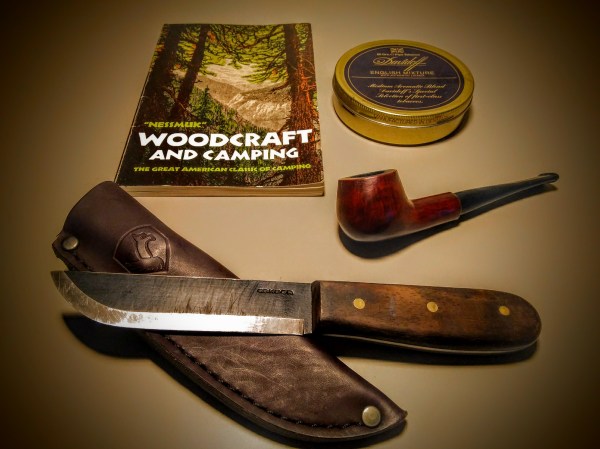
The book begins by touching on the point that too often we have the same attitude towards recreation that we do of our work: that it must be done quickly and always at an advanced level. Sears mentions that it’s no wonder that we find ourselves overwhelmed with schedules and exhausted even on vacations. For reason unknown, we apply the same stressors of our work lives to our personal lives. The misguided belief that money equates to enjoyment is also carried over. Packs laden with the latest expensive gadgets (only to be used once and promptly forgotten) are not uncommon. The author preaches that if we truly want to enjoy a nature, it’s best to do so in a way that doesn’t distract us with over-complication.
In regards to equipment, Sears’ ideology is clear: travel light, carry only what’s needed, and improvise the rest. In the authors word’s, Woodcraft and Camping is not written for “the man of millions”, but for the man who finds himself overworked from a year’s labor and is deserving of a summer outing despite his comparatively meager earnings. Because of this, a large portion of the segment on equipment includes instructions on how to improvise and create gear with what items the reader may have on hand. Those that enjoy bushcraft will find this particularly interesting. Sears covers crafting everything from knapsacks to tents in great detail, accompanied by clear illustrations. If one is to follow Sears’ directions, they stand to spend only a fraction of the usual equipment costs and have a traditional kit that will be the envy of outdoorsman everywhere.
Along with the many equipment recommendations are explanations of the skills needed to properly utilize them. For those that want to simplify their time in the wilderness and go back to their roots, the skills imparted in this book will be indispensable. In the modern world of backpacking stoves and ultralight tents, the knowledge of how to construct an effective cooking range or shelter with only the surrounding material is becoming much less common. One may say that our technology negates the need to learn primitive skills, but that is far from the truth. Sooner or later, equipment will fail; if the difference between a hot meal and a less than filling dinner of granola is taking the time to learn how to construct a proper cooking fire, I would recommend taking the time to do so. Similar lessons abound in Woodcraft and Camping.
Perhaps the most enjoyable parts of the book are the anecdotes given by Sears. The seasoned woodsman has always been a mythological figure among storytellers, especially as our society’s interests shift from appreciating the past to anticipating the future. To read the deepest thoughts of such a man humanizes what is now a storybook character in our minds. Sears writes with sincerity and a genuine desire to educate and encourage following generations to step away from hectic lifestyles and immerse themselves in an environment that fosters self-sufficiency, curiosity, and a deep appreciation for the natural world. The book is formatted in a conversational style that makes the reader feel as if they are sitting around a campfire with the woodsman himself. The stories within are sure to please.
The books title reads “Woodcraft and Camping” and is followed by the tagline, “The Great American Classic of Camping”. While usually I scoff at a self-proclamation, Sears’ book is well-deserving of such a title. It has educated and inspired for over 100 years, even being mentioned by other prolific wilderness writers such as Horace Kephart. At 128 pages, Woodcraft and Camping is short enough for a quick read and small enough to fit in your pack easily. It is listed on Amazon for only $7.95, a steal considering the wealth of knowledge the book contains. I encourage any curious woodsman to pick up a copy, sit at the campfire, and lose yourself in the writings of one of the men that helped create the wilderness culture we enjoy today.
Enjoy reading and keep your boots wet.
 Wet Boots, Worn Packs, and Other Wonderful Things