If you’re into bushcraft, chances are you’ve heard of Morakniv. Based in Mora, Sweden, Morakniv has been producing knives for the campsite to the kitchen since 1891. Though all of Morakniv’s offerings are superb (along with their prices), let’s focus on the knife that is looked at as the standard for affordable bushcrafting knives: the Mora Companion.
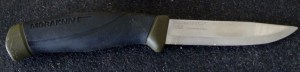
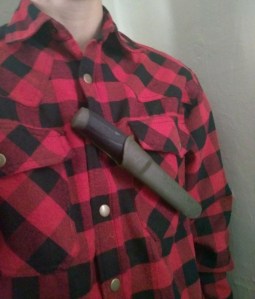
Well known for its steel quality, ergonomic handling, and a price that near anyone can afford, the Mora Companion is the perfect knife for the fledgling woodsman and the mountain man alike. For a mere $14.95 on bladehq.com you get a 4.1 inch Scandi grind drop-point blade comprised of hardened 12C27 Sandvik stainless steel with a Rockwell hardness of 56-58. The 4.6 inch TPE rubberized polymer handle is designed to be short enough for small hands yet at .79 inches thick enough to fill the hand of those with bear paws. As a man with smaller than average hands, I find the Companion can be used for long periods without causing fatigue or hot spots. The molded polymer sheath can be carried using the belt clip or with a button hole in the back of said belt clip to allow for the Companion to be carried on the outside of a coat for easy access in colder a climates. A decidedly Scandinavian feature in my opinion.
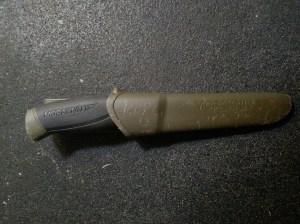
While simple, the sheath boasts excellent retention through a friction lock system and has a drain hole at the bottom to help keep the already corrosion-resistant blade dry even in the wettest conditions. Mine sheath been dragged over rocks, through the mud, and dropped many times without showing any signs of loosening or damage.
The Mora Companion has a rat-tang blade, meaning the blade extends 3-quarters into the handle of the knife before stopping short of the pommel. While this initially concerned me, I’ve come to trust the construction of the the knife. A well-made rat-tang knife will perform far better than a poorly made full-tang knife. If you’re limited by your budget I encourage you to look past the tang of the blade and choose the Companion over a low-quality full-tang knife. The Companion will likely be more affordable as well.
Because of the Companion’s rat-tang, I wouldn’t recommend using it for heavy batoning, though it can handle processing kindling between 1 to 2 inches. Where the knife really excels is its ability to handle finer tasks such as making tinder, carving, and food prep. Because of its lighter construction the knife weighs in at only 4.1 ounces, including the sheath. It is perfect for extended hikes where the weight of your kit must be considered. As it’s said, ounces are pounds and pounds are pain.
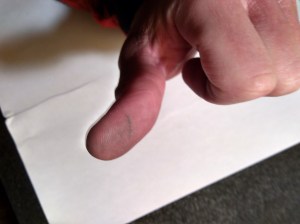
As I do for all of my testing, I sharpened the knife to a razor edge beforehand. Being that the blade has a Scandi grind, an incredibly sharp edge can be achieved. In fact, while sharpening the Companion I took my eyes off of the knife for one moment and felt the blade slip and slice across the tip of my finger. My first thought was, “Well, this will be a trip to the ER”. I looked down and to my surprise saw a hair-thin incision through the very top-most layer of skin. There was no pain or even blood, only a tiny slash with flecks of metal deposits from the sharpening process. Few bush knives have an edge precise enough to make a cut with the delicacy of a surgical scalpel, but the Mora Companion does.
As for the testing process, I feel it would be redundant to demonstrate the usual wood processing and food prep that the Companion is already well-known for. Instead, I chose to demonstrate not only the ability, but the finesse of the of the knife as well. I split a small piece of oak for my work stock and got to work on some feather sticks.
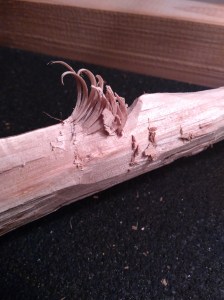
A streak of creativity struck me as I looked at the bullet-nosed piece of oak in my hand. The feather sticks almost looked like the plume of a bird or the fins of a fish. Deciding to see how far I can take it, I touched up the nose then began to create a face. I used the tip of the blade as an awl to make a starting point for two center cuts. I carefully pried the grain out between these cuts and smoothed the inside of that space. Next I came around to the bottom of the nose to carve out a mouth. I notched the wood parallel to the bottom of the workpiece, smoothed out the roof of the notch, and carved the bottom of the notch into an inward facing crescent for the lower jaw. Seeing now that this creature was beginning to resemble a shark I smoothed out the sides, bellied the bottom, and carved in a notch at an acute angle to give the appearance of a fin. I then tapered the rear end of the workpiece to finally stop at what would be considered a tail and serve as a small point to grasp in my fingers. An hour or so later I set down the finish project. I must say, I’m happy with how it turned out for a spur of the moment idea.
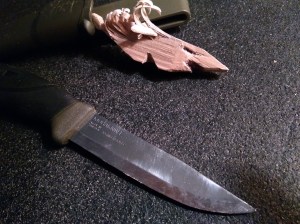
Many knives can perform the usual tasks of wood processing and carving, but few can with the finesse of the Mora Companion. With that thought in mind, it’s important to remember the Companion’s price point when comparing its ability to other knives. While a $100+ dollar knife may be able to handle the same tasks with equal ease, it will cost more than 6 times as much money. Mora has not only created an outlier, but a gem. The Companion is a stand-out knife in a sea of cheap, Chinese-made knives. Whether you will be using the Companion as your primary knife for a stay in the wilderness, splitting your sausage to roast over a fire, or sitting around the fire whittling a stick, the Mora Companion will meet your needs.
Buy Swedish and keep your boots wet.
 Wet Boots, Worn Packs, and Other Wonderful Things