Gerber is a company with a checkered past among knife enthusiasts. Alternating periods of exceptional designs with quality manufacturing and periods of questionable design choices with poor materials have shaken some customer’s trust in the nearly 80 year-old company. As of late it seems Gerber has been attempting to push into another new period of excellence. They’ve gotten themselves well-established in the military/tactical gear market, have brought forth creative rescue and utility tools, and have even offered an affordable selection of knives manufactured here in the United States. The Gerber Gator line of knives is one of those American-made models.
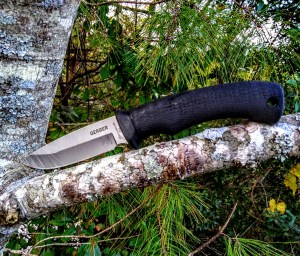
Marketed as general utility knife, the Gator takes a no-frills design and improves the ergonomics without modifying it beyond its needs. The line features both folders and fixed-blade models offering drop-point blades with either a plain edge, partially serrated edge, plain edge with a gut hook, or a fillet knife. All share Gerber’s Gator handle pattern, a textured rubberized grip meant to provide superior handling when wet or dry. In this review we’ll be looking at the plain edge fixed blade variant.
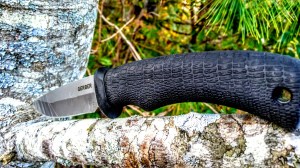
Retailing for as low as $35.00, Gerber is offering a lot of knife for a low price. A full-tang blade of 420HC steel is encompassed by a thick glass-filled nylon handle with Gerber’s Gator pattern. The sheath is made out of a durable ballistic nylon with a molded plastic insert to prevent the blade from puncturing. Now, while on paper this sound may sound excellent, there is one caveat to my review: the factory edge grind on my Gator was incredibly uneven and required me to regrind the blade, a task I wasn’t quite sure how to do when I purchased the knife. Later when I dug out the Gator and gave it a proper edge, I continued to find faults in the steel. Let’s move forward with that in mind and I’ll expand on it soon.
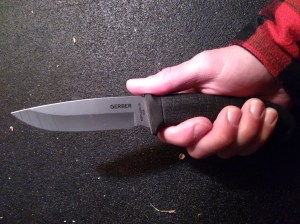
When handling the knife the first thing to “grab” your attention is the grip. Gerber clearly put some thought into the Gator pattern. It is soft and forms around the hand nicely. I have small/medium hands for a man and it fits my hand while still having enough room for those who need more. There is a gentle curve downwards towards the end of the handle which provides surface area without being excessively long. A lanyard hole is present as well. One flaw I found in the handle design is that due to a swell acting as a guard, choking up on the spine of blade is uncomfortable and doesn’t allow for even thumb contact. A strange design choice for a knife with such a generous finger choil.
I’m of the opinion that a well-made knife isn’t worth carrying if its in a sub-par sheath. Fortunately, the Gerber Gator doesn’t disappoint in regards to that. The ballistic nylon used is thicker than even the fabric on many tactical bags. It is riveted around the molded plastic insert that will prevent puncture and protects the blade in the event that you land on your sheath after a fall.

The retention straps that snap around the handle are a bit thin, but passable. The reason I don’t have more qualms with these straps is because, even without them, retention is superb. The knife sits deeply in the sheath and the rubberized grip provides the friction needed to see that the knife did not fall or jiggle even when upside down. That is what I want in a sheath.
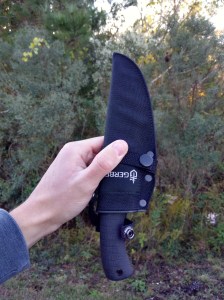
The belt loop on the sheath is made with the same ballistic nylon as the sheath, though thicker and stiffer. At the bottom of the belt loop are straps that wrap around and snap at the front of the sheath. The purpose of this is to make it possible to unsnap these buttons, slip the belt loop out above your belt, and remove the sheath.
So we have an excellently designed handle and sheath. There’s two-thirds of the complete package, but what about the most important part, the blade? Well, that’s where I have some issues.
The blade is a 4.02 inch drop-point blade comprised of 420HC stainless steel with a Rockwell hardness of 58. There are many positive reviews of the Gator online, so I’m left to assume that the factory edge is usually good, but again, mine was not. On top of that, I have reason to believe that the heat treatment on my Gator was not done properly. It’s fragility and inability to cut well was immediately noticeable. When dealing with the defective factory edge I became frustrated after trying different angles and sharpening methods (and as you can see, scratching the finish in the process). Two years later I pulled it out and spent two hours with a whet stone, evened out the bevel, and brought it to a razor edge before testing.
Being that the Gator was designed to be used in wet environments with it’s purpose-built grip and corrosion-resistant blade, I tested the the knife’s performance on damp hard and soft woods. Unfair some may say, but I prefer to test under realistic conditions. I began by batoning the blade through a 2 inch thick piece of damp pine. There was some difficulty biting into the wet softwood, but once through to the inside grain the Gator split the wood with ease.
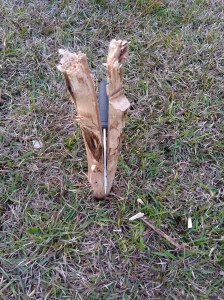
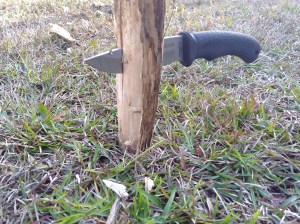
I didn’t want to push the blade too far beyond its limits, but while it was wedged in the wood I decided to gently twist the blade to torture-test its prying ability. Interestingly, the blade remained in place while the handle twisted securely in my hand. This is a testament to the Gator’s superior grip and keeps the blade from being over-stressed. I’ve never encountered this with a knife before and liked the idiot-proof safety measure.
Next I used the blade to shave off the bark of a damp piece of oak. Only a small amount of material was removed with each swipe. Small nubs on the surface would almost stop the blade completely or cause it to glance off. With enough effort, the knife was able to eventually handle removing the nubs. I’ll note that with dry wood the Gator performs acceptably at these tasks, but I’ve had cheaper knives that performed much better when working with damp wood, so this is hard to excuse.
At this point the blade was dulling quickly. Now, I know Gerber’s 420HC isn’t known for its edge retention, but this was unprecedented. I owned a Gerber Prodigy (I regret selling it every time I open my knife drawer) that also had a 420HC blade and it handled the same tasks and more without any problems. Granted, blade geometry and the grind play a large part in edge retention, but I still expected more of the Gator.
After it’s difficulty shaving I was beginning to doubt the knife’s abilities. The next test was notching. With the Gators inability to remove damp material, even with large swipes, I expected that carving smaller notches with shorter movements would be even more difficult. Surprisingly, the knife performed well.
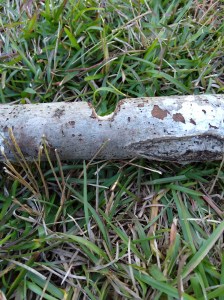
When carving larger notches it’s inability to remove material was apparent again. It was a more time consuming process than usual, but still possible.
Testing its namesake, I then soaked the handle and repeated these tests. The Gator handled just as well and produced the same results, so while it’s performance wasn’t stellar, my ability to control the blade was unaffected. It certainly lives up to it’s slimy reptilian name.
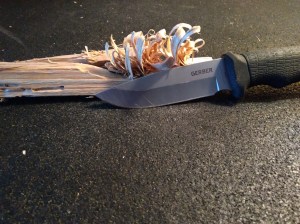
After touching up the edge I took a piece of oak with dry, exposed grain and tested the knife’s ability to make feather sticks. I didn’t have much surface area to work with so the feather sticks are short, but if it’s any indication to how it would perform with a larger plain the Gator did well.
As a final test of the blade’s strength I lightly stabbed the blade into a mimosa tree. Mimosa is similar in density to pine, but more forgiving due to the lack of thick sap. Still, when I removed the blade I found the point had been bent. I’ll note again that I lightly stabbed the knife into the tree. The tip should not have bent under that stress. This, along with its defective factory edge and poor edge retention leads me to believe that the Gator I have received an improper heat treatment. While that hasn’t been uncommon with cheaper Chinese Gerbers in the past, the Gator is one of their models that is produced here in the United States. When customers purchase a knife manufactured in the US they expect higher standard to be met, particularly when being American-made is one of the emphasized selling points.
There we have it. While Gerber designed a decent knife that (judging by other online reviews) performs well, my Gator failed to meet those marks. It makes me wonder about Gerber’s consistency, even with their knives manufactured in the United States. The Gerber Prodigy I had was American-made and an excellent knife, but my Gator has let me down. I’m hesitant to purchase other Gerber products because of this.
So would I recommend the Gerber Gator? Maybe. The knife has a good reputation, but mine has significant flaws. You can chalk it up to the luck of the draw, but that shouldn’t have to be the case. If you want an affordable American-made fixed-blade knife, take your chances. The odds are probably stacked in your favor, but the possibility of getting a dud is there.
Stay sharp and keep your boots wet.
 Wet Boots, Worn Packs, and Other Wonderful Things