If I told you that only a short drive from Los Angeles is the ruins of a self-sufficient Nazi commune would you believe me? Obscured by both myth and hidden intentions lies just that. Enter: Murphy’s Ranch.
In 1933 a plot of land was purchased in Rustic Canyon, Los Angeles by Jessie M. Murphy. The thing is, as far as history can prove, Jessie M. Murphy never existed. The name is found on the deed to the property and nowhere else. The true landowners were Winona and Norman Stephens, a wealthy couple of Nazi sympathizers. Anticipating America’s loss of the Second World War and the coming Nazi invasion, their plan was to retreat to the hills, wait out the conflict, and then emerge to help establish Nazi rule over the United States. Planned for the ranch was a 4-story manor house, raised gardens, it’s own water supply, a diesel generator for electricity, and even a bomb shelter. The scariest part: they almost got there. On December 8th 1941, the day after the Pearl Harbor attack, their terrible dream was cut short when police swarmed the compound, arrested all 50 of the land’s caretakers, and halted construction. But not before progress was made and you can see that for yourself.
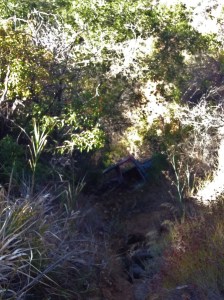
The 4 mile hike begins at the end of Casale Road in Pacific Palisades, C.A.. Pass through the yellow gate and continue down the paved fire road. There is a steep drop-off on one side of the road. With a close eye, you may see what remains of some unfortunate motorists.
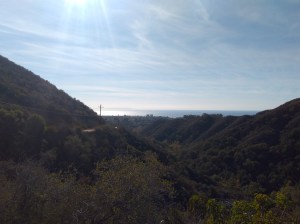
Along the road you’ll be treated to a fantastic view down Rustic Canyon and the ocean beyond.
To this point the hike poses little challenge, but that soon changes. Ahead you will find a rusted chain link fence. There will be an opening in the fence that leads to you to what at first seems like a simple set of stairs. Prepare yourself.
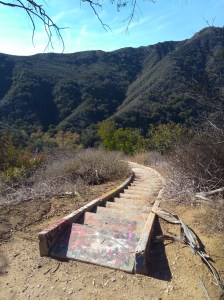
These stairs will take you directly to the canyon floor. There are no switchbacks and they do not level off at any time. Use extreme caution. You will find that the steps are shallow and the terrain is steep, requiring a gait that doesn’t feel very natural.
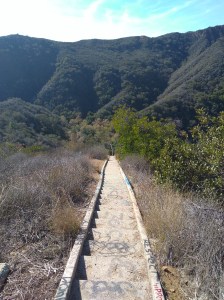
The steps continue through a few thickets which will provide some much needed shade along the way. The descent and balancing required to keep your footing will take its toll on your knees, so take the opportunity to rest out of the sun.
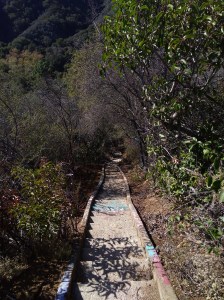
The final third of the steps are badly eroded. Many have crumbled and those that remain pitch up at nearly a 20 degree angle at times. Some sections are best done using the tried-and-true butt scooting method.
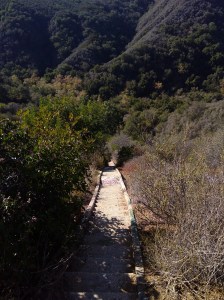
At the bottom a short trail will take you to a road that once ran throughout the compound. The valley air was cool, there was a gentle breeze, and the sound of the world beyond was blocked by the cliffs above. It was strangely peaceful given the canyon’s disturbing past. Be warned, all cell service was lost and few other hikers make the descent. Should you hurt yourself on the stairs or beyond help may not be available. See my article about preparing for a survival situation.
When the trail comes to a road along the canyon floor take a left. This will take you into Murphy’s Ranch. You will shortly see a retaining wall on your right that graffiti artists have taken to be their canvas. If you enjoy graffiti art, the best is yet to come. A bit further the road will fork. Both will lead you to the powerhouse, a massive concrete structure that contained the diesel generator, but the path on the right will also take you through the raised garden beds as well. These gardens were once meant to grow the crops that would sustain the Nazi holdouts during a war that fortunately never came.
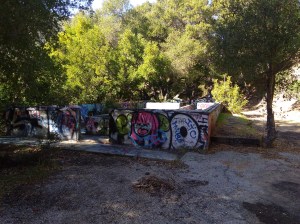
Walk just past the garden beds and you will be overlooking the powerhouse, now a vibrant piece of art standing out among the trees.
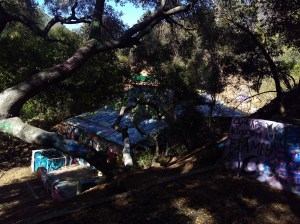
The artwork on its walls is stunning. While I normally dislike finding graffiti in the wild, and I will point out that it’s illegal, I like to look at this art as a sort of statement, a statement that the land has been reclaimed by those free to express themselves.
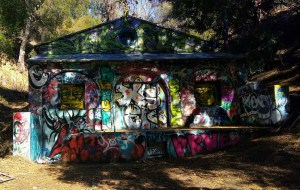
Past the powerhouse you may notice a concrete slab on the right of the trail. This is where a machine shed once stood, but it has recently been torn down. Take note: from here on, the trail is not blazed. Don’t be afraid to turn around if you feel that you’re heading off of the main trail. Now you will travel through a clearing and along a creek bed with dense brush. It is eroded and muddy. Use caution or you may end up falling into the overgrown creek. Once through the brush you will come into what feels like a small pasture. The stables, or what’s left of them, are ahead.
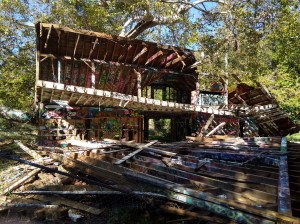
While fascinating to look at, I recommend against exploring the ruin. It has been fenced off by the state for safety reasons. Debris litters the fenced-in area and the structure itself is falling down.
Soon after the stables the trail will become a road again and gradually climb out of the canyon. At the top you will come to the fire road you began on. Make a right onto the fire road and walk along it back the way you came.
All in all, hiking Murphy’s Ranch is a peculiar blend of nature, art, history, and mystery. To walk the grounds that were once held by American Nazis and see what it has become provokes many thoughts. It makes one think hard on what was, what’s now, and what could have been. Certainly a hike unlike any other; if you find yourself in L.A. it’s one I highly recommend.
Enjoy the trip and keep your boots wet.
 Wet Boots, Worn Packs, and Other Wonderful Things