It can happen to anyone: One wrong turn leads you miles off course. An unexpected storm blows in. You’re caught out as the sun sets. Would you be ready? A little preemptive thinking can serve one well to avoid such things, but if you fail to do so, that problem is now in the past. What you do now is what matters and, whatever you do, you better do it right.
If you’re going to hammer a nail, you’re going to need a hammer. The same principle applies here: Use the right tool for the job. Prepare for the possibilities and have what you’ll need to handle them. No one schedules a survival situation. Below I will list the basic items you should have in your pack at all times, why they should be there, and how they work together.
Rain Shell: In mountainous regions a clear day and a downpour may only be a ridgeline apart. Varying air temperatures and pressures often creates immediate precipitation that cannot be predicted. Distant terrain features may block the horizon, leaving one with little notice when dark clouds spill over from a neighboring valley. As cold water covers the body it rapidly decreases body temperature, allowing hypothermia to set in sooner. Saturated fabric will keep cold water on your body after the rain has passed, extending these dangerous circumstances long after the storm. Remember, hypothermia is still a threat outside of the winter months. Due to a lack of preparedness, hypothermia claims more lives during the summer months than during the winter.
Firestarter: You’ve failed to pack protection from the rain, the storm has halted your movement, the temperature is dropping as night falls, and, even though the rain has passed, you’re soaked to the bone. You need to be dry and warm or things will quickly go from bad to worse. With the proper knowledge a fire can be made even in wet conditions, but you’ll need a firestarter to do so (unless you’ve mastered the bow-drill method). A fire is the one thing that can save you under these circumstances. It will warm the body, dry your clothes, and lift the spirit. Creating a fire will give you a sense of progress and recovery. It will make it feel as if you have taken steps to gain control of the situation. A simple lighter is effective, but not reliable. A wet lighter will fail to ignite. It is easy to lose track of how much a lighter has been used and find it out of fuel. Pack a backup method that will work under any conditions and does not rely on a finite source fuel. My recommendation is a ferro rod, which relies on the friction between a rod made out of ferrocerium and a striker to throw sparks that are up to 5,430 degrees Fahrenheit. With practice and the right tinder a fire can be had no matter the weather or altitude.

Knife: Above I mention using the right tinder. With your surroundings soaked it may seem that dry tinder is unavailable, but with a fixed-blade knife of quality steel and solid construction that is easily remedied. As long as deadwood is present, a knife can be used to process the wood into serviceable pieces. Below is how to do this:
– Begin by gathering large branches, preferably with a diameter between one and four inches. Position the wood so that it is standing on its end perpendicular to the ground. Lay the blade of your knife on the center of the top end. Using a second stout piece of wood, carefully hammer the blade through the first piece wood, acting as a wedge. Be sure to have the forward end of the blade protruding enough to continue hammering the blade through the length of the wood. Once halved, split the two pieces into fourths using the same method. The center of the wood will be dry and the exposed grain will burn readily, giving you kindling. This technique is known as batoning.
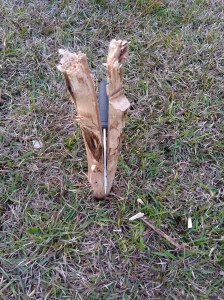
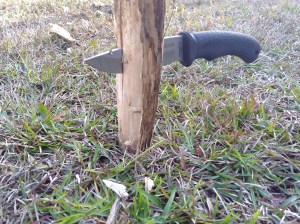
-To ignite your kindling you will need smaller pieces of wood to burn. Collect sticks and use your knife to shave off the wet surface layer. If you can break these sticks off of the larger branches you’ve collected earlier a considerable amount of time and energy will have been saved. When finished you will have a large amount of thin, bare sticks that will burn well and serve as your initial small fire once ignited by your burning tinder.
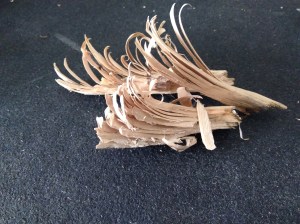
-Lastly, and most importantly, you will need tinder as the foundation of your fire. Split or shave wood as you have been doing to expose the dry grain. Place the edge of your knife at a steep angle and shave the surface along the grain, removing only the top-most layer of wood, creating a long strand. Stop your cut so the strand is long and curls, but not removed from the piece of wood. Do this along a single plain, stopping just short of your last strand. You will quickly have a mass of curly strands that will take a flame easily due to the increased surface area and being paper-thin. These are called feather sticks. It is also acceptable to shave off a very large amount of thin shavings and pile them at the base of your fire area as your tinder (though this becomes a more time-consuming process after you collect each shaving and put them into a pile). Once you have your feather sticks or pile of shaving, light them and they will quickly burn, starting your fire. Once you have your fire, shave your remaining pieces of wood and set them next to the fire to be dried.
With your fire roaring and your body warm, you now have to prepare to settle in for the night. Being that you have been forced to into an extended stay, you’ll have to address long-term needs, such as shelter, food, water, and rescue.
Shelter: A simple lean-to shelter can be constructed using your knife to cut and shape branches to the desired size. If pine trees are present cut the boughs and make a bed out of those. The layers of pine needles make for excellent insulation and are quite soft. If you choose to plan ahead, a 10×10 nylon backpacking tarp takes up little space in a pack. A tarp shelter can be easily erected with 550 cord and will provide better protection from the elements.
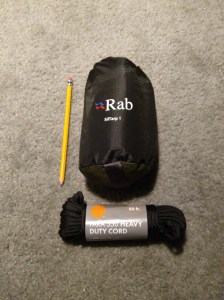
Food: Without the knowledge of hunting or foraging, food can be difficult to procure in the wild. I suggest bringing along high-calorie foods that are only to be eaten in an emergency. Meal-replacement bars do well, as well as candy for the calories and sense of luxury it provides to keep morale high.
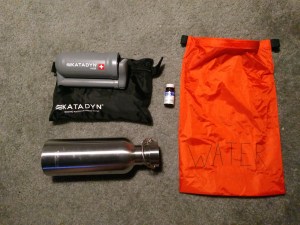
Water: In regards to consumables, your top priority should be clean drinking water. Once dehydrated you will suffer cramps, weakness, low energy, and impaired judgement to start. Drinking unpurified water can lead to parasites and viruses that cause severe diarrhea and vomiting, which will dehydrate you even further. As we all know, you will quickly deteriorate both physically and mentally without water. Under normal circumstances, you will die of dehydration in three days. If help is far removed it may take longer to be rescued. To put that into perspective, each day without water is a third of your remaining time on Earth.
Water purification tablets are lightweight and effective. Some purify water in just thirty five minutes. Should you neglect these when packing, you can still do well in the hypothetical scenario we’ve been discussing. A simple water bottle made out of food-grade stainless steel will allow you to boil water and continue to serve as a portable vessel. Under 6000 feet bring your water to a rolling boil for at least one minute before drinking. At altitudes over 6000 feet, three minutes. If you don’t plan on carrying a filter or tablets to purify water, at least see that you have a container to boil water in.
Rescue: With your long-term needs met, now you must do all you can to facilitate rescue. The best thing you can do now is stay where you are. You have everything you need to survive for the time being and are hopefully somewhat near where you intended to be, which is where search and rescue teams will begin their search. Granted, there are situations that moving may be acceptable, such as if you know exactly where you are and were simply halted for the night. If you are truly lost, by moving you increase the odds that you will be traveling further away from help.
Signalling devices are invaluable while awaiting rescue. Items like signal mirrors are well-known, but there are other devices available as well. To start, anyone that goes into the wilds should be carrying a whistle. I recommend one designed to be as loud as possible, such as the S.O.S. Rescue Howler Whistle. Familiarize yourself with the Morse code form of S.O.S. (three short bursts, three long bursts, three short bursts). The sound of a whistle travels many times farther than a person’s voice. If you see people a far distance away, a whistle makes it possible to get their attention. For signalling at night, there are many flashlights available with strobe modes, some even have modes that message S.O.S. visually. Items such as flares may not be allowed to be carried under local laws. As always, do your research.
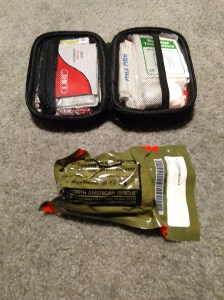
First-Aid: Also relevant to rescue, a well-stocked first aid kit and the knowledge to address basic injuries is a necessity. Be sure that it’s contents are not passed their expiration dates. Carrying items such as medications, antiseptics, and dressings should go without saying. While I do feel comfortable administering basic first-aid, I will not give medical advice as I am not qualified to do so. Obtain a first-aid kit and know how to utilize the items inside of it.
While all of this may seem like a lot to carry, remember that the purposes of these items are to cover your basic needs. These are needs that must be met in your daily life, even at home. To venture out into the wilds, a place that you are inherently disadvantaged, without these items can turn a rescue mission into a recovery mission. There are many things that are out of our control when we leave the safety of civilization, but our personal preparedness is not one of them.
Be prepared and keep your boots wet.
 Wet Boots, Worn Packs, and Other Wonderful Things